What is colour temperature?
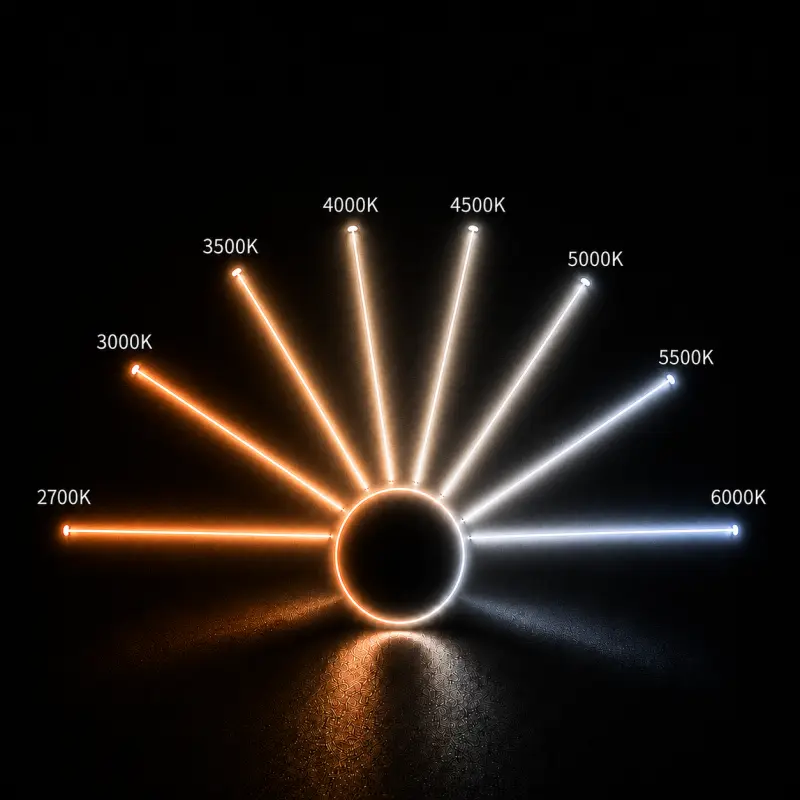
The correlated colour temperature, abbreviated to CCT, describes the apparent hue of the white light emitted by a light source.
Its value is expressed in kelvin, abbreviated to K.
In simple terms, it allows us to distinguish between light that is perceived as warmer, neutral or cooler:
- at around 2700–3000 K, the light has warm, yellowish tones;
- at around 4000 K, the light appears more neutral and balanced;
- from 5000 K upwards, it takes on a cooler appearance, with a greater blue component.
It may seem counterintuitive, but a lower value in kelvin corresponds to warmer light, whilst a higher value corresponds to cooler light.
However, colour temperature does not indicate either the quantity or the quality of the light. Two light sources with the same luminous flux can have different tones and produce completely different perceptions of the same environment.
A choice determined by the application
There is no single ‘correct’ colour temperature. The choice depends on the intended use of the space, the activities carried out there, the surfaces present, and the visual experience one wishes to achieve.
Warm light is often chosen for spaces where one wishes to create a feeling of comfort and welcome, such as hospitality venues, relaxation areas or catering facilities.
Neutral light, generally around 4000 K, is widely used in offices, commercial premises, healthcare facilities and professional spaces, as it promotes a clear and balanced perception.
Cooler tones may be used in specific operational contexts, but must be carefully assessed to avoid creating a perception that is overly stark or uncomfortable.
The colour temperature must therefore be selected by considering not only the desired atmosphere, but also the visual performance required by the activity.
A real-life example: the operating theatre block at M. Bufalini Hospital
In operating theatres, lighting plays a particularly critical role.
These environments must ensure reliable, uniform visual conditions that comply with precise operational requirements. The choice of colour temperature must therefore contribute to visual clarity and the comfort of staff, whilst ensuring high levels of illuminance, glare control and accurate colour perception.
In the multi-specialist operating theatre block at the M. Bufalini Hospital in Cesena, the lighting design involved upgrading the L 590 IP65 luminaires through a retrofit solution.
The project improved the performance of the operating theatres whilst retaining the existing infrastructure and minimising the impact of the installation work – a particularly important consideration in sterile environments designed for specialist surgery.
The upgraded luminaires were configured with a colour temperature of 4000 K, chosen to provide neutral, bright and balanced light, suitable for supporting activities where precision and visual reliability are essential.
The solution also guarantees superior colour rendering, with a CRI greater than 90, illuminance levels compliant with application requirements, and compliance with the UNI EN 12464-1 standard.
In this context, colour temperature and colour rendering work together: the former defines the overall hue of the light, whilst the latter enables colours, surfaces and details to be correctly recognised.
The project demonstrates how, in healthcare environments, the choice of CCT cannot be based solely on aesthetic preference. It must form part of a comprehensive lighting system capable of ensuring visual precision, comfort, safety and operational continuity.
Discover the case study of the M. Bufalini Hospital and find out more about the lighting solution developed for the operating theatres.
The right tone for every space
Choosing the colour temperature means establishing the character of the light and the way in which people will perceive the environment.
The value expressed in kelvins is a key reference point, but it must always be assessed alongside colour rendering, illuminance levels, light distribution and the activities carried out in the space.
Because lighting design is not just about deciding how much light to provide, but also creating the most suitable visual conditions for every environment and every activity.