Located in the heart of Rome, along one of the capital's most iconic streets, the redevelopment of Via Veneto 89 transformed the historic headquarters of IRI into a modern corporate headquarters that successfully combines the architectural value of the original building with the evolving needs of today's workplaces.
Covering more than 16,000 m², the project represents an outstanding example of urban regeneration, where sustainability, technological innovation and architectural quality converge into a single, coherent vision.
The achievement of LEED®, BREEAM® and WELL® certifications demonstrates a commitment not only to energy efficiency but, above all, to the well-being of the people who use the building every day.
Within such a prestigious environment, lighting is far more than a technical system: it becomes an architectural element capable of interacting with the spaces, enhancing materials and contributing to visual comfort throughout every working activity.
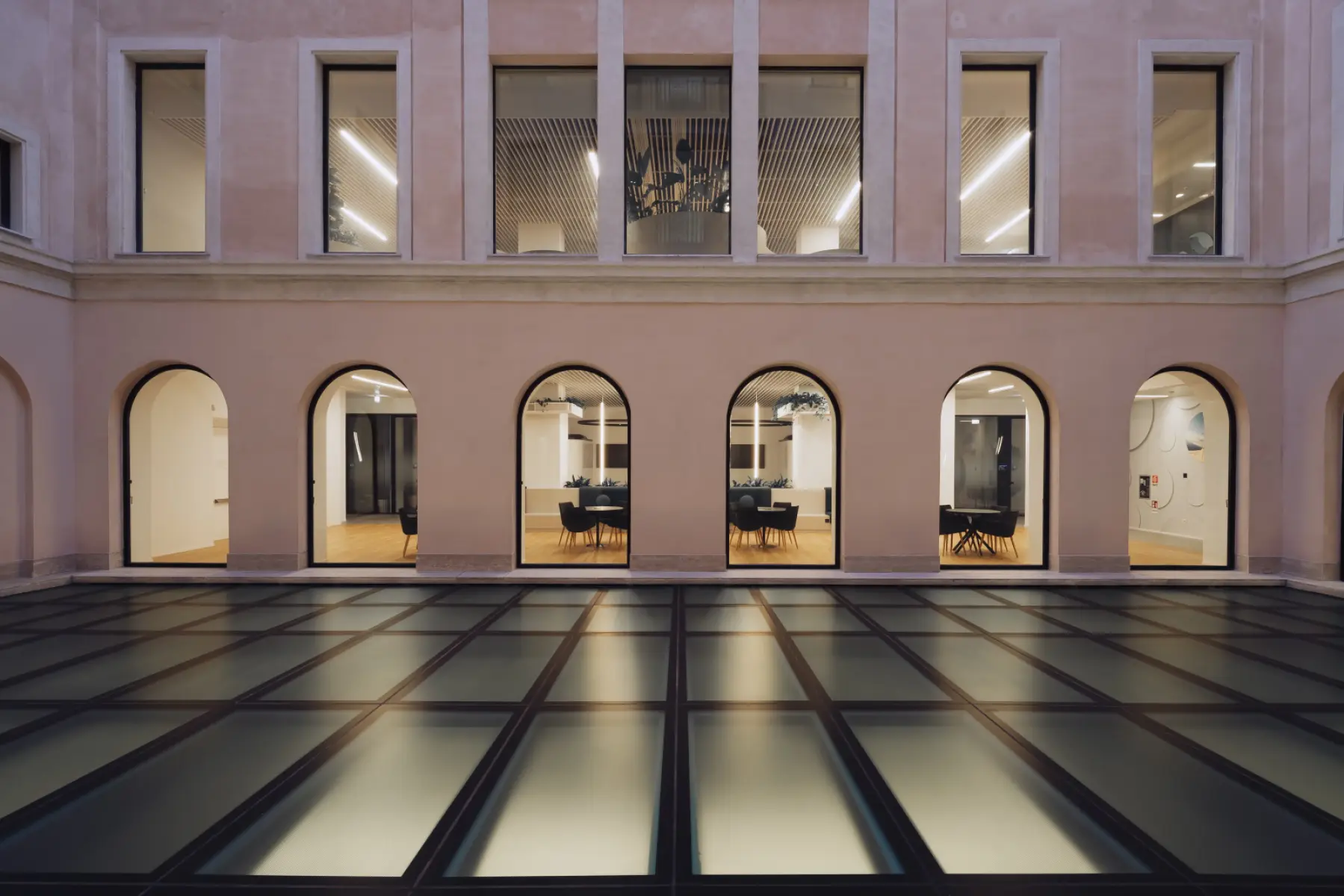
One of the project's most demanding aspects was the remarkablefunctional diversity of the interior environments.
Open-plan offices, executive offices, meeting rooms, collaborative spaces, lounges and representative areas all required significantly different lighting solutions, both in terms of technical performance and user perception.
The design objective was to develop a lighting system capable of adapting to each environment while maintaining a consistent aesthetic identity throughout the building.
Lighting needed to complement the architecture without overpowering it, ensuring outstanding visual comfort, seamless architectural integration and maximum flexibility in the management of lighting scenes.
To meet these requirements, a dedicated configuration of 3F Hal was developed through the collaboration between 3F Filippi andScandurra Studio.
More than a simple lighting fixture, 3F Hal is a modular lighting system designed to interact naturally with contemporary architecture. The 75 mm, 150 mm and 300 mm versions were selected according to the requirements of more than 750 workstations and the different characteristics of each space.
From a lighting engineering perspective, 3F Hal integrates three independent light emissions: direct light with a microprismatic diffuser and UGR <19, indirect light for ceiling illumination, and an integrated Spot module for accent lighting or to increase illuminance where required.
Independent control of the three lighting components allows the creation of up to eight configurable lighting scenes, adapting every environment to changing operational needs.
Why it was selected
• Dedicated 75 / 150 / 300 mm versions
• UGR <19 with controlled luminance
• Direct, indirect and Spot lighting
• Eight configurable lighting scenes
• Premium design with seamless architectural integration
The lighting design for Via Veneto 89 follows the principles of the modern Human Centric Workspace, where lighting quality directly contributes to well-being, productivity and the overall workplace experience.
The outstanding glare control allows employees to work comfortably for extended periods at computer workstations, while the indirect lighting creates brighter, more balanced and visually comfortable environments.
The integrated Spot module introduces an additional level of flexibility, enabling meeting tables, reception areas, collaborative spaces and architectural features to be highlighted without compromising the overall lighting identity of the project.
The collaboration between 3F Filippi and Scandurra Studio demonstrates how lighting design can become an integral part of architecture and contribute directly to the overall value of a building.
The integration of design, LED technology, intelligent lighting control and outstanding lighting performance has resulted in a system capable of simultaneously meeting the requirements of international building certifications, user expectations and the architectural vision of the project.
Via Veneto 89 therefore stands as a benchmark for contemporary premium office design, where lighting is no longer merely a technical element but a strategic component capable of enhancing comfort, energy efficiency and the quality of everyday working life.
Do you have a similar project?