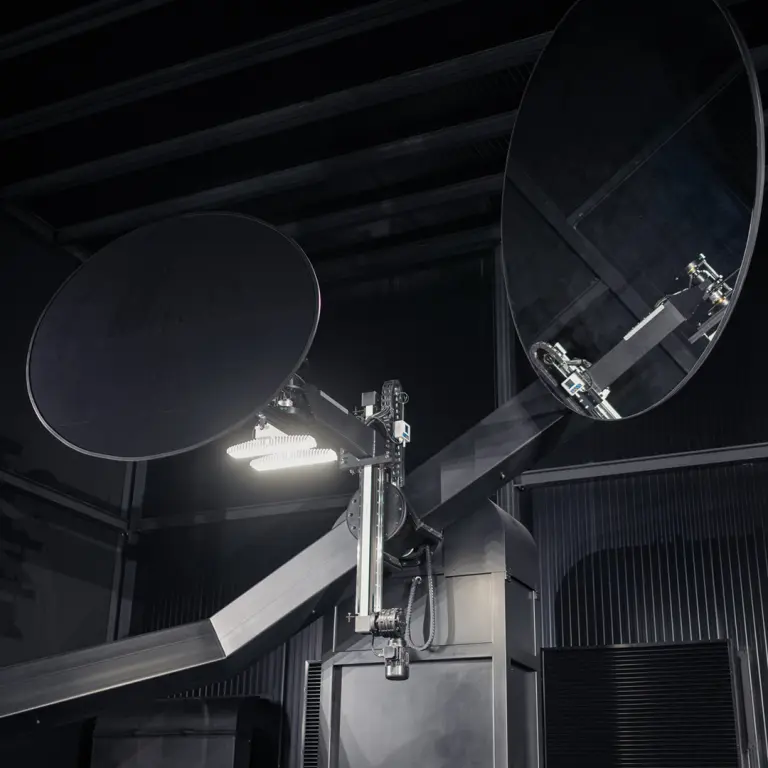
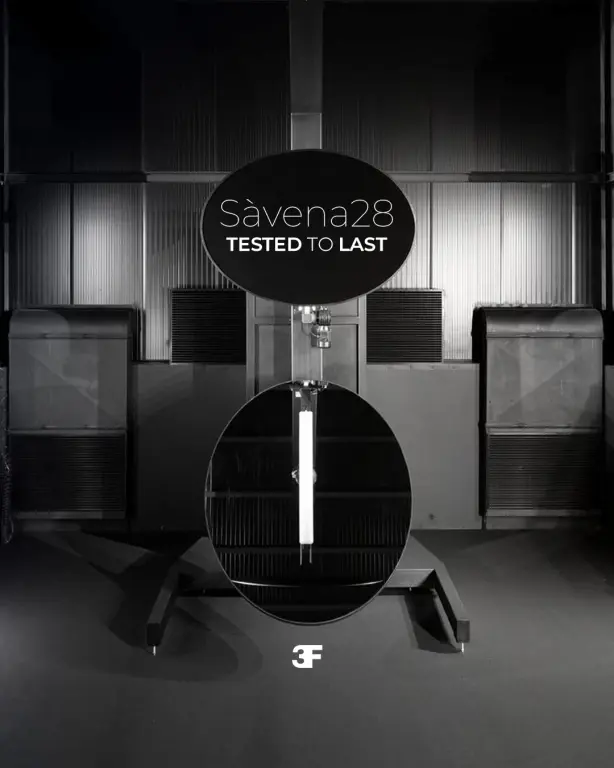
What is a goniophotometer?
A goniophotometer is a measuring instrument used to analyse the
distribution of light emitted by a luminaire in different directions in space.
During the test, the luminaire is measured at different angles,
allowing its luminous emission to be reconstructed accurately.
The result is therefore not just a luminous-flux value, but a true
map of the light, useful for understanding whether the distribution is wide or
concentrated, symmetrical or asymmetrical.
From measurement to the photometric curve
The collected data are converted into photometric curves and files
that can be used in the main lighting design software packages.
This allows the designer to place the luminaire virtually inside a
space and predict how the light will behave before installation.
This is fundamental because two luminaires with the same luminous
flux can produce completely different results depending on their optics and
beam distribution.
Measuring means verifying the design
The goniophotometer is not used only to generate data for software.
It is also a verification tool during product development.
A new optic, a different diffuser geometry or a change to the LED
source can alter the behaviour of the light. Measurements therefore make it
possible to compare what was expected during design with what the product
actually produces.
The process becomes: design → prototype → measurement → analysis →
optimisation.
In this way, photometry becomes an integral part of product
development and helps make performance measurable, verifiable and repeatable.
The goniophotometer in the 3F Filippi laboratory
In the 3F Filippi photometric laboratory, the goniophotometer is
used to verify luminaire behaviour and generate the data required for lighting
design.
Measuring light distribution makes it possible to verify
performance, efficiency and optical quality, turning the real behaviour of the
luminaire into information that designers and technicians can use.
Together with testing and inspection activities, the photometric
laboratory is therefore a key step between development, verification and the
finished product.
Measuring light to make it predictable
Lighting design works with something we cannot touch: light.
To use it precisely, it has to be transformed into data.
That is exactly what the goniophotometer does: it measures what the
eye perceives and translates it into objective information for the project.
Because good light should not only be designed. It should be
measurable, verifiable and predictable.
Discover the 3F Filippi R&D laboratory and learn more about our
approach to measuring light.