What does luminous efficacy really mean?
The luminous efficacy of a luminaire is generally expressed in lumens per watt, lm/W.
This value relates the emitted luminous flux, measured in lumens, to the electrical power absorbed.
Put simply, the more lumens obtained from one watt of power, the more efficient the luminaire.
Advances in LED technology have made it possible to achieve increasingly high efficacy levels, significantly reducing energy consumption compared with traditional lighting technologies.
There is, however, an important difference between luminaire efficacy and system efficiency.
The first concerns the performance of an individual product. The second considers how its light is used within a space: where it is directed, how long it remains on, the power level at which it operates and the actual needs it serves.
This is where lighting design plays a fundamental role.
The right light, where and when it is needed
An efficient installation does not necessarily have to produce less light. It has to use the amount of light that is needed.
Light distribution should be selected according to the environment and the activities carried out within it, directing the luminous flux where it is genuinely required and avoiding waste.
Efficiency can be improved even further by controlling how long the lighting operates and at what intensity.
Conditions in professional environments change continuously. Occupancy may vary throughout the day. Daylight from windows and skylights may increase or decrease. Some areas may be used only at certain times.
Keeping the system at 100% output at all times means ignoring these variations.
Lighting management systems, sensors and dimmable luminaires can instead adapt the lighting automatically to the actual conditions within the space.
When daylight increases, the artificial contribution can decrease. When a space is unoccupied, the lighting level can be reduced or the system can switch off. When the activity changes, the lighting conditions can change with it.
Efficiency therefore becomes dynamic.
DALI, sensors and daylight
One of the technologies most widely used to manage luminaires in professional lighting is the DALI protocol.
A DALI system makes it possible to control and dim luminaires individually or in groups, create different scenes and integrate presence and light sensors.
The principle is simple: at any given moment, provide only the artificial light needed to achieve the conditions defined by the lighting design.
Daylight management is a particularly effective example. A sensor can detect the level of light already available in the space and adjust the luminous flux of the luminaires accordingly.
Where a significant amount of daylight is already available near a window or skylight, luminaires can operate at a lower output than those located deeper inside the building.
The result is a correctly lit environment in which energy use is better aligned with actual needs.
The same principle can be applied through presence sensors in intermittently used spaces such as warehouses, corridors, service areas or specific production zones.
The lighting system is no longer simply on or off: it becomes capable of responding to what is happening in the space.
A real-world example: MY WOOD
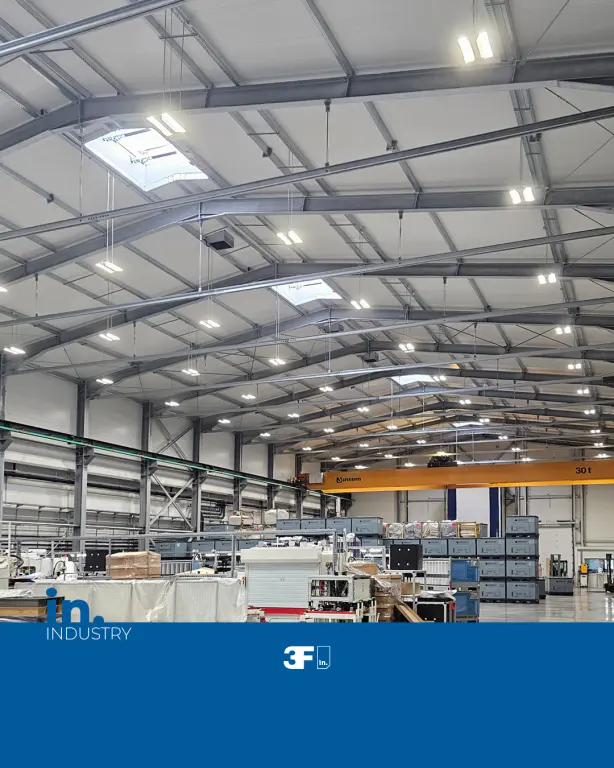
Efficiency is especially relevant in industrial environments. Large areas, long operating hours and different working conditions can make lighting a significant part of a facility's energy consumption.
In the project developed for MY WOOD, the objective was to combine light quality, robustness, visual comfort and lower energy consumption.
3F Rover DALI was selected to illuminate the facility. Designed for industrial applications, the luminaire was configured with different optics to suit the various operational areas.
Thanks to the DALI protocol, the system can adjust the luminous flux according to daylight availability and the actual use of the spaces.
The luminaires therefore do not necessarily operate at full output at all times. Instead, they modulate their contribution to maintain the lighting conditions defined by the project.
Luminaire efficacy, light distribution and the control system work together.
The result demonstrates that lower energy consumption does not depend solely on selecting a high-performance LED source, but on creating a system in which every component contributes to the overall efficiency of the installation.
From product efficacy to project efficiency
Assessing a luminaire through its lumens-per-watt value remains important, but it is no longer enough to describe the energy performance of a lighting project.
Real efficiency comes from the combination of several elements: high-performance luminaires, suitable optics, correct light distribution, control systems, sensors and lighting design.
It means using the amount of light required, in the right place and at the right time.
Because designing an efficient lighting installation does not simply mean consuming less. It means using light better.