When does a lighting installation become intelligent?
An installation does not become intelligent simply because it can be controlled through an app. Its intelligence comes from the ability to understand what is happening in a space and respond consistently.
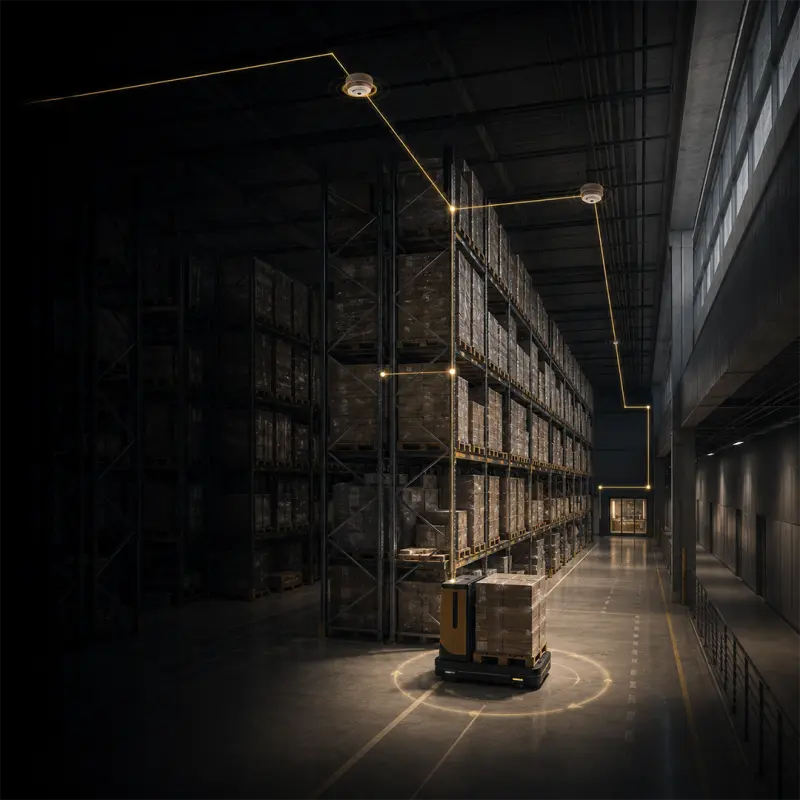
Light levels can be reduced automatically in rarely used areas. Near windows or skylights, artificial light can adapt to the daylight already available. In a space used for different purposes, dedicated scenes can change intensity and lighting conditions.
The system therefore uses information from the environment to provide the conditions defined by the design at any given time. Adjustment is no longer an occasional action, but a continuous process.
For this to happen, luminaires, sensors and control devices need to communicate through a common language.
DALI: a common language for light
DALI stands for Digital Addressable Lighting Interface, a digital protocol developed for professional lighting control.
Unlike a conventional command that acts on an entire circuit at once, DALI can address individual luminaires or organise them into groups. It can dim output, recall scenes, change configurations and adapt system behaviour without necessarily modifying the power wiring.
Communication is bidirectional: the system not only sends commands but can also receive information from connected devices. This makes it possible to understand system status and build more advanced control functions.
DALI does not decide how much light a space needs. It is the tool that allows lighting design, sensors and management logic to work together.
Sensors: light responds to the space
Sensors are the point of contact between the lighting installation and what happens in the environment.
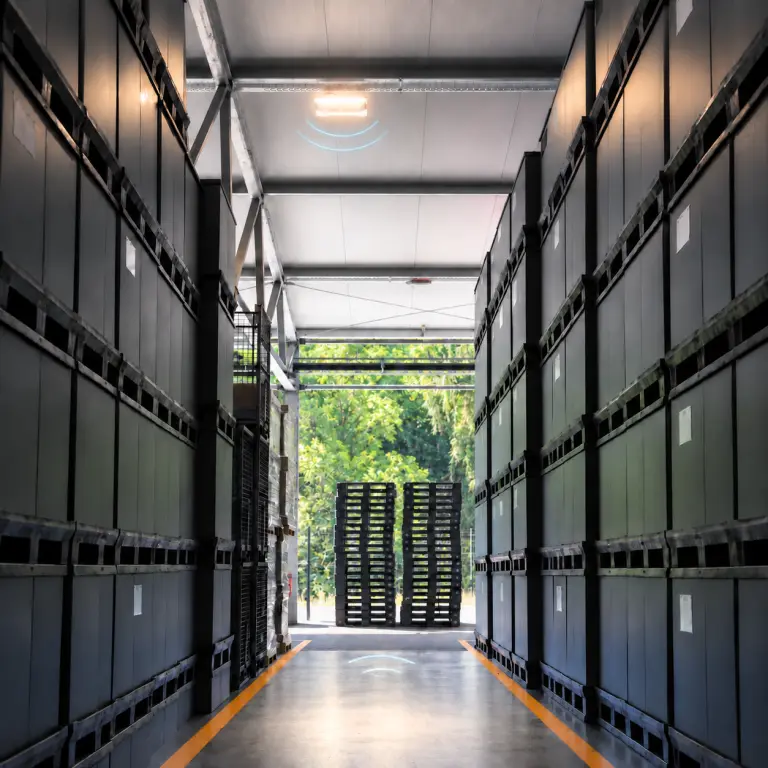
Presence sensors detect whether spaces are in use and allow light to be reduced or switched off in unoccupied areas. Light sensors measure the daylight contribution and enable luminaires to modulate their output to maintain the required level.
The two types of information can be combined. An office near the facade, an intermittently used corridor or a production area active only during certain shifts should not always be illuminated in the same way.
The quality of the result still depends on design. Sensor position, response times, minimum levels, zoning and scenes must reflect real activities. Effective automation should feel natural rather than intrusive.
From commands to data
The new generation of DALI systems is not limited to controlling light. Dedicated specifications allow drivers to make useful installation data available.
Part 251 covers luminaire information; Part 252 enables energy reporting; Part 253 introduces diagnostic and maintenance information, including operating hours, temperatures and fault conditions.
These data can improve knowledge of installed assets, verify energy consumption, identify anomalies and schedule work before a problem leads to disruption.
Lighting therefore moves from being a system that is merely controlled to a source of information. Its value lies not only in automation, but also in the ability to make decisions based on real data.
Lighting within the Smart Building
In a Smart Building, lighting, HVAC, shading, security and energy management do not operate as completely separate systems. Supervisory platforms and gateways can share information and coordinate building behaviour.
Occupancy data gathered for lighting can help describe how spaces are used. Energy information can feed monitoring systems, while diagnostic alerts can support facility managers and maintenance teams.
The European framework for building energy performance also places increasing emphasis on automation and automatic controls in non-residential buildings where technically and economically feasible.
The objective is not technology for its own sake, but a building that is more efficient, reliable and responsive.
A real-world case: Piacenza railway station
A railway station is a complex infrastructure, operating around the clock and subject to demanding requirements for safety, service continuity and maintenance.
3F X8 Rail was selected for Piacenza railway station. Developed specifically for railway applications, the luminaire is designed to provide robustness, visual comfort and lasting performance.
The solution integrates wiring compliant with the RFI product register and based on the DALI-2 Data protocol. It supports luminaire data storage, energy monitoring and advanced component diagnostics through Parts 251, 252 and 253.
Lighting therefore contributes not only to the quality and safety of the space, but also to infrastructure management. Available information can support asset control, maintenance and service-disruption prevention.
It is a practical example of how an IoT-ready luminaire can evolve from an end device into an information node within the installation.
Explore the solution developed for the infrastructure: discover the Piacenza railway station case history
Designing a system, not only selecting luminaires
DALI, sensors and data collection expand what professional lighting can do, but technology alone does not guarantee an effective result.
The process must begin with an analysis of spaces, activities, operating times and management objectives. Only then can zones, scenes, sensors, dimming levels and genuinely useful information be defined.
Lighting becomes intelligent when the complexity of the system remains invisible to users and translates into comfort, efficiency, operational continuity and greater control.
The future of lighting is not only about higher-performance luminaires. It is about systems that can observe, communicate and adapt.