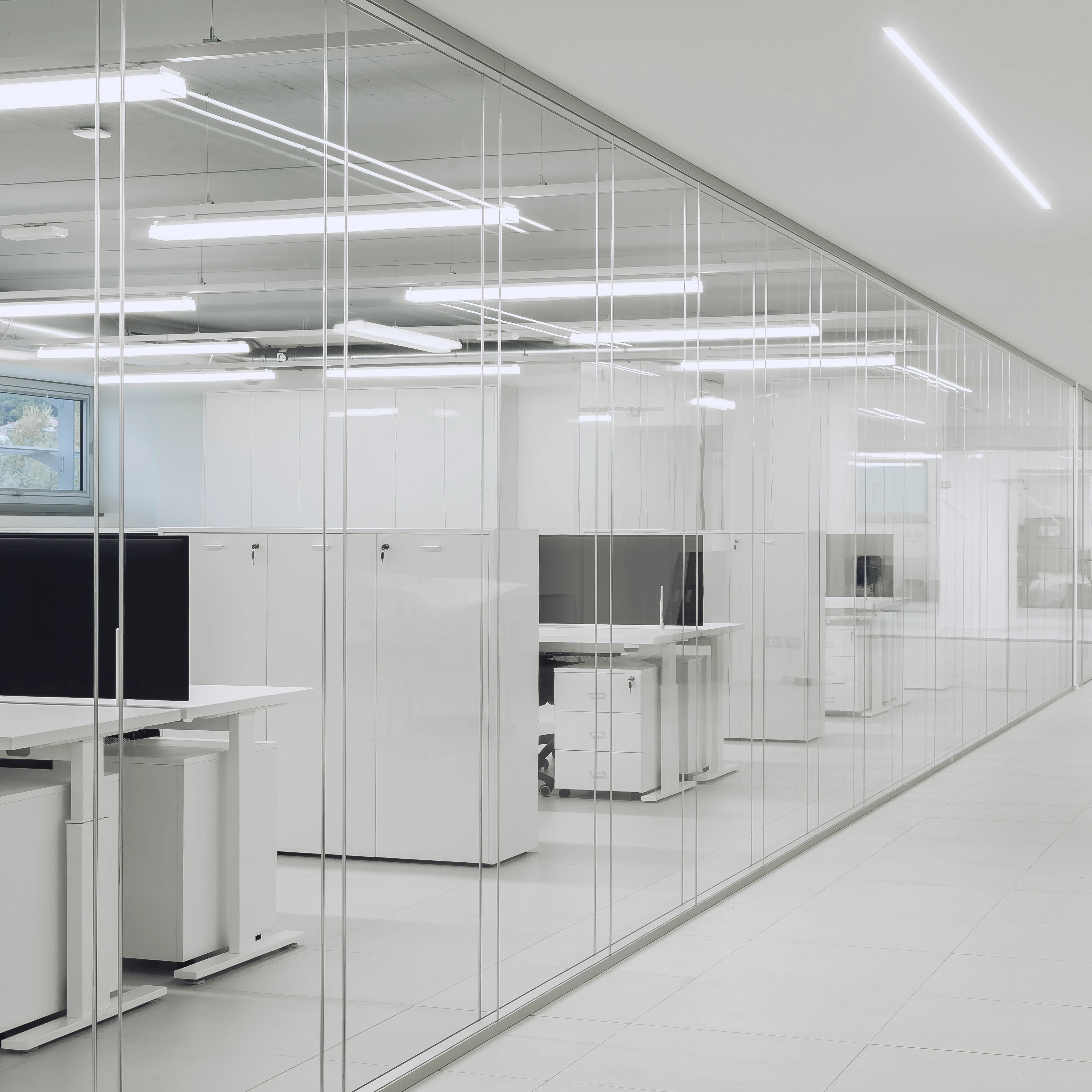
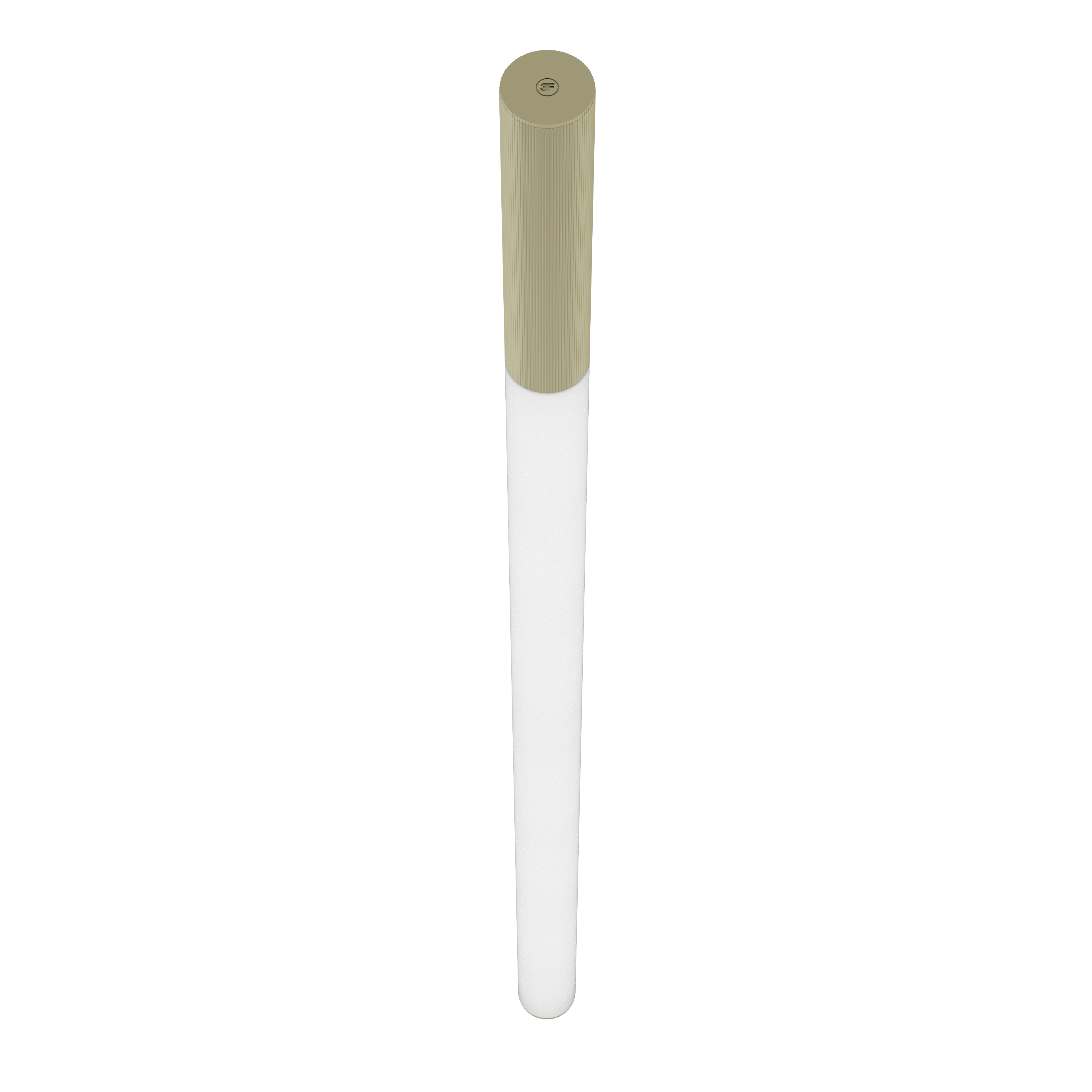
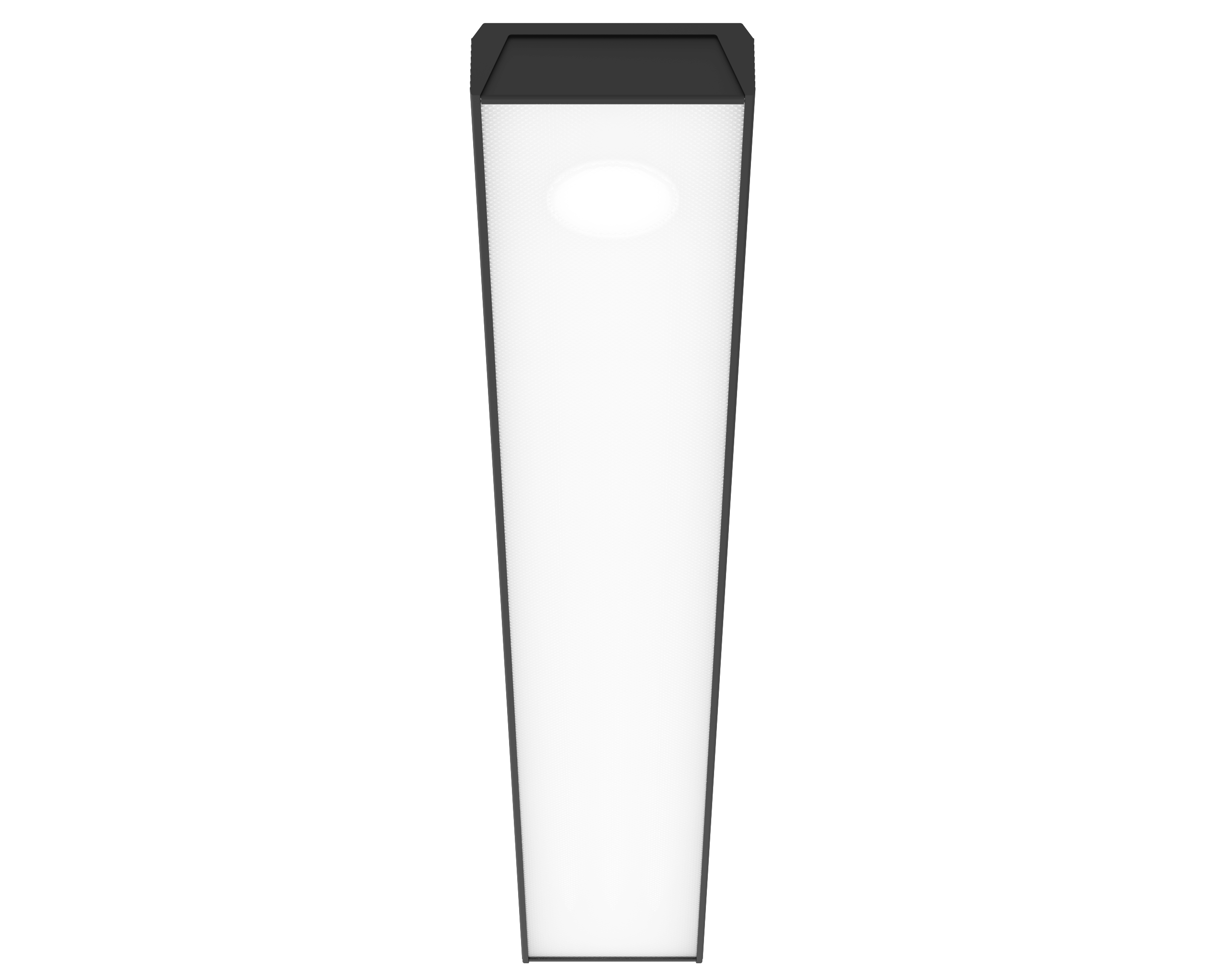
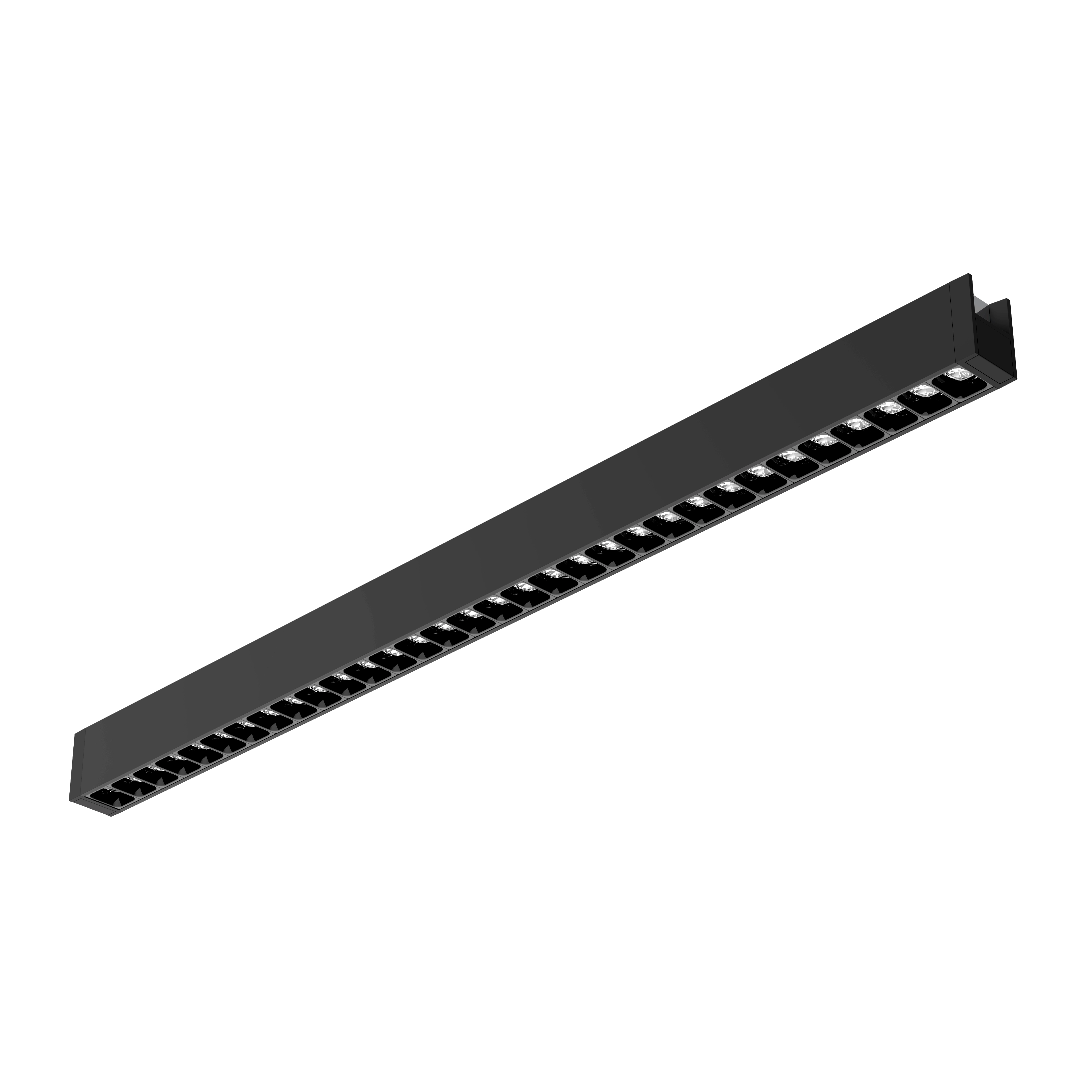
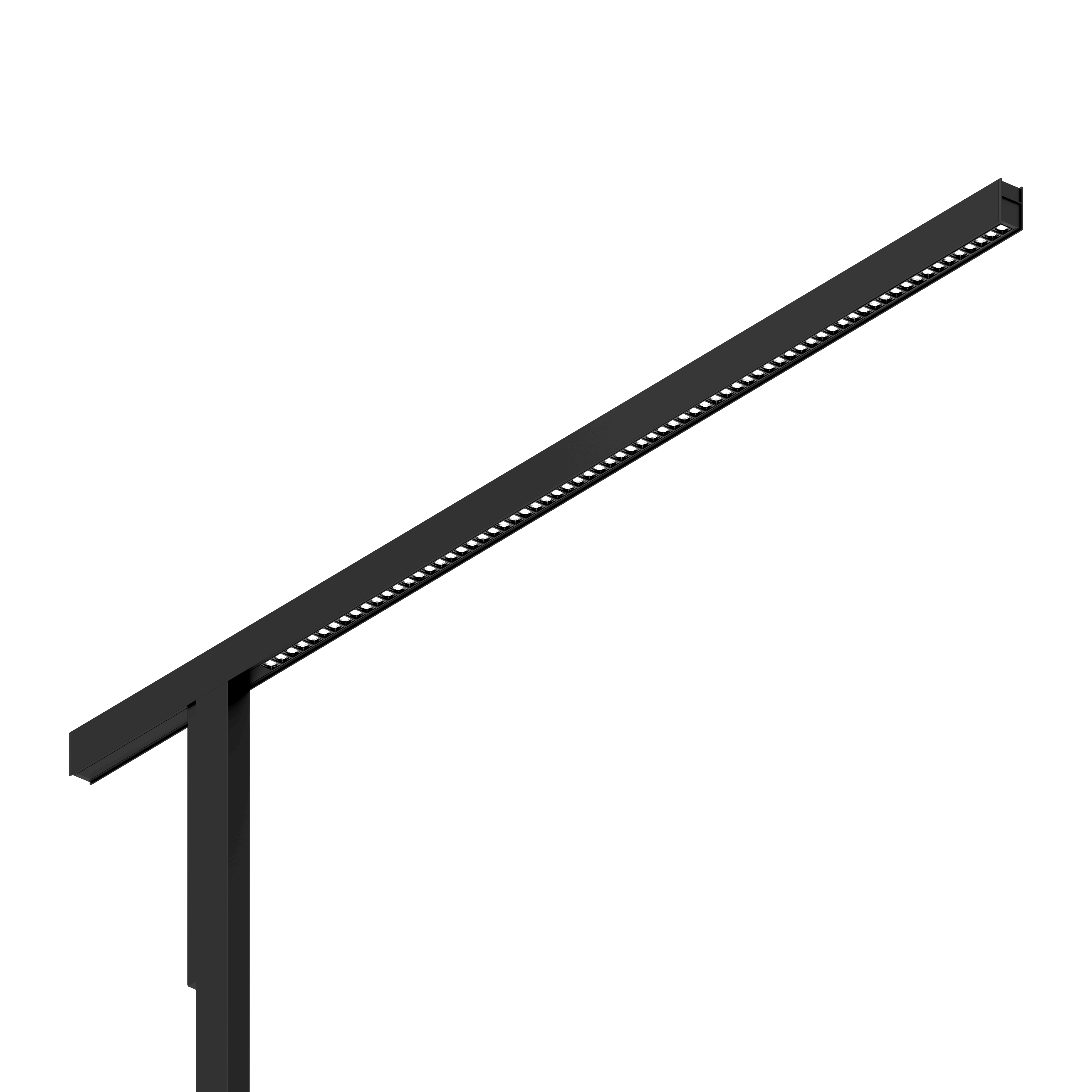
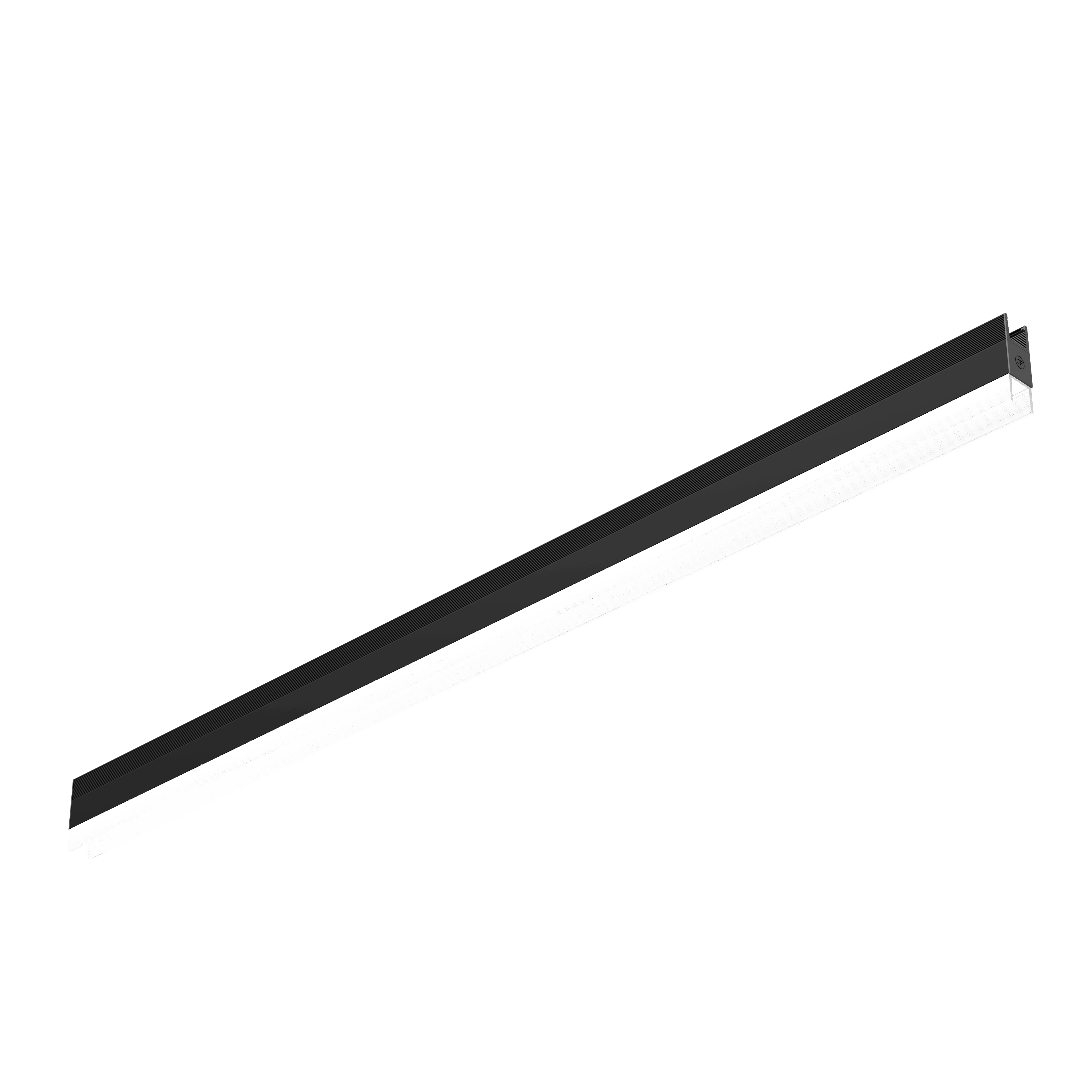
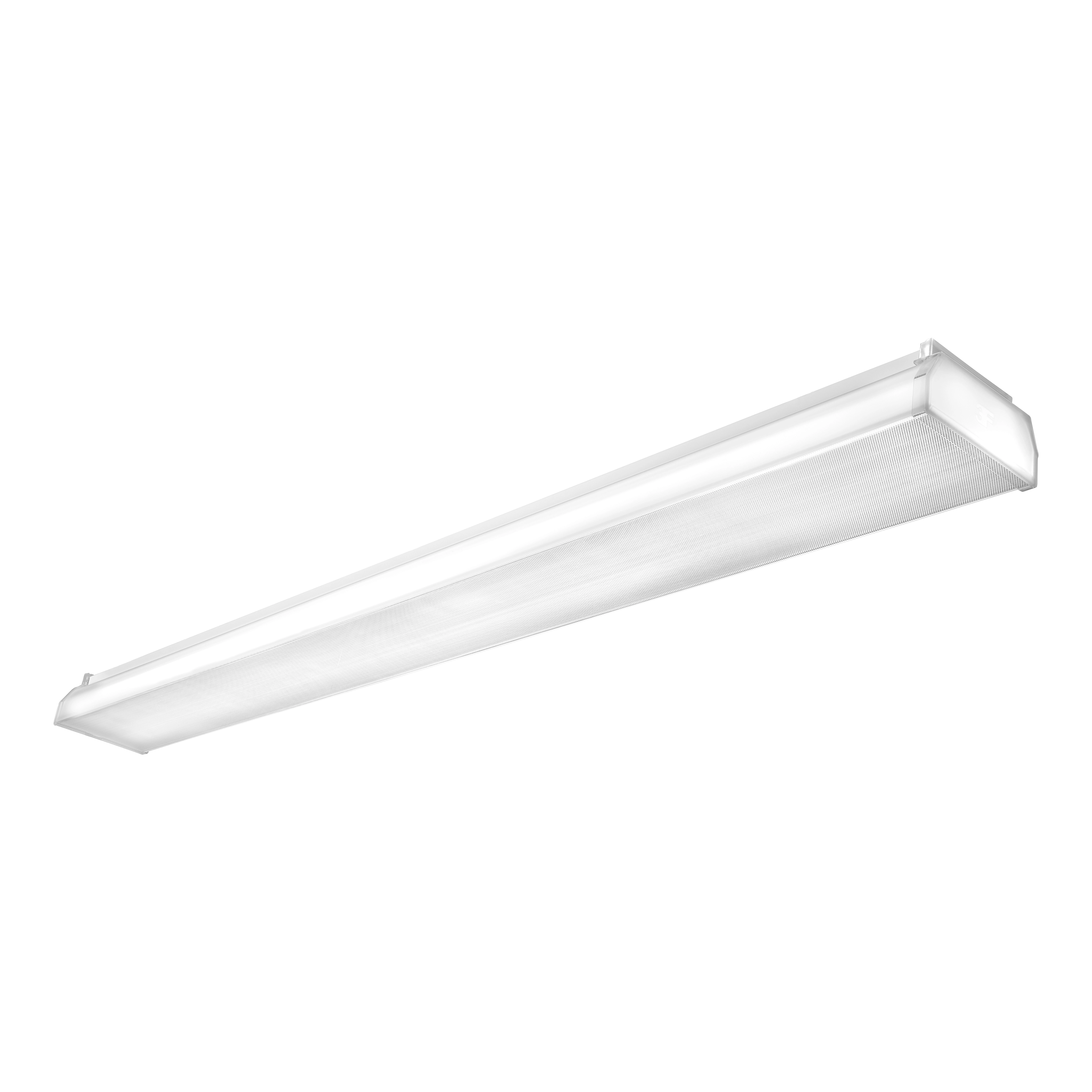
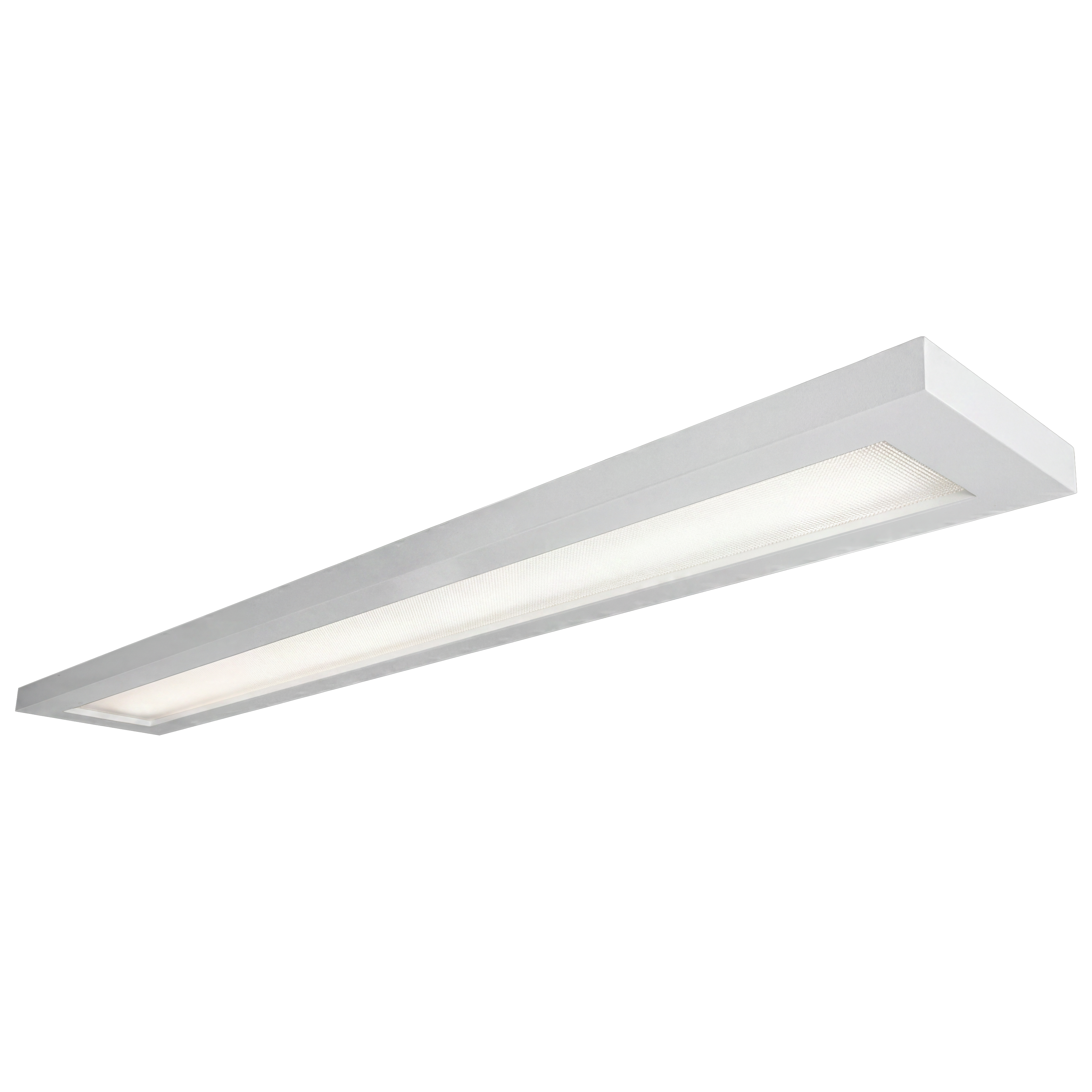
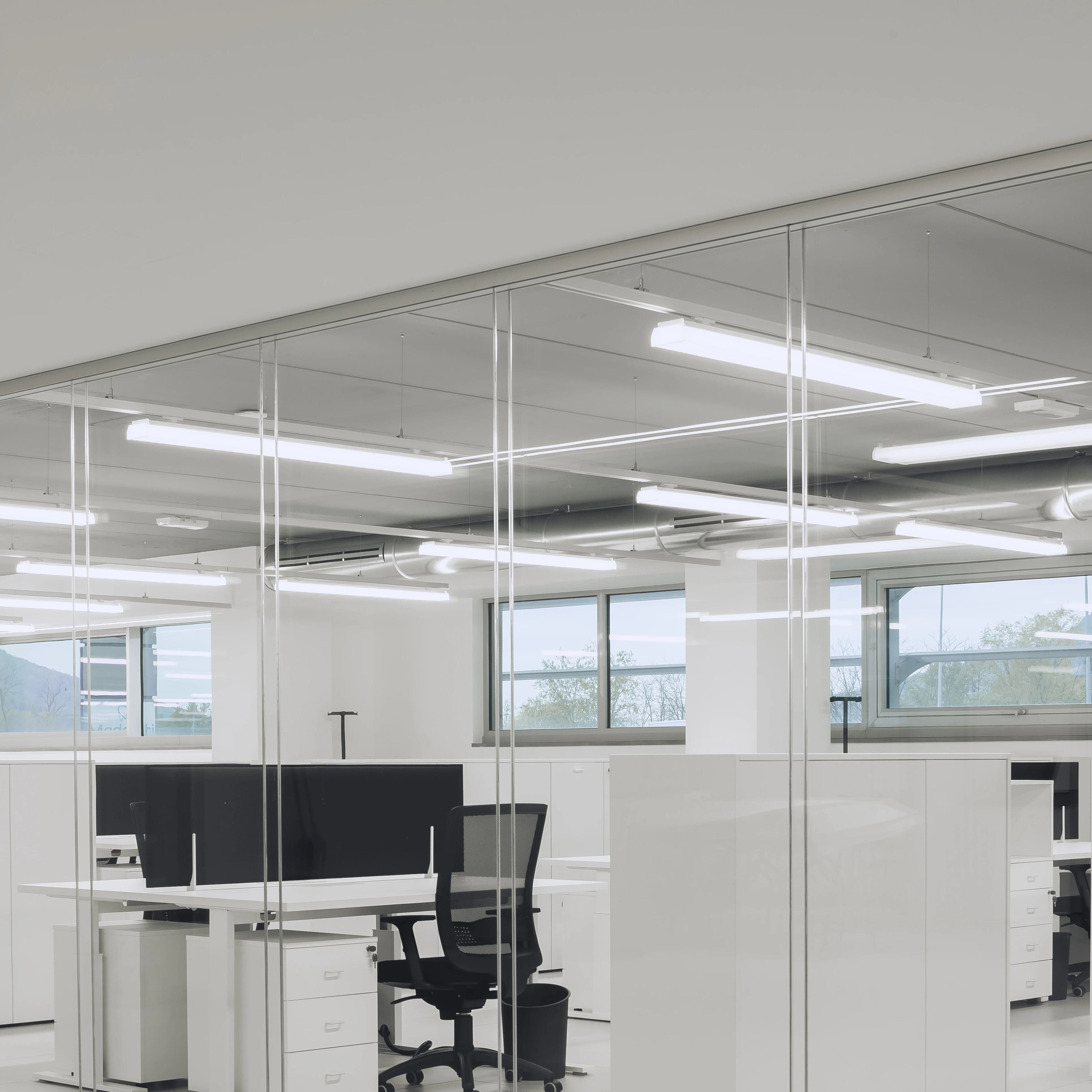
On site, «relamping» has come to mean two very different jobs. The first is replacing the lamp only — an LED tube slid into the old fitting — which costs little, keeps an optic designed for a different source and often makes glare worse. The second is replacing the complete luminaire with one designed for LED, mounted on the same lighting point and the same electrical line. The second is what 3F Filippi calls relamping, and it is the only one that brings the office up to standard as well as down in cost.
The right question is not «how much does it cost» but «how much does it cost not to do it». A 4×18 W fluorescent fitting draws around 80–100 W with its ballast; the LED luminaire replacing it draws 30–36 W to give more light, with a service life three times longer and no tubes to change. In an office of two hundred fittings running 2,500 hours a year, the difference shows on the bill from the first month.
This page describes the process step by step, the equivalence between what is there and what replaces it, and the payback figures. The requirements the new installation must meet are explained on the office lighting page; if the relamping is the occasion to add sensors and controls — and it usually is — the smart office lighting page says how much they yield.
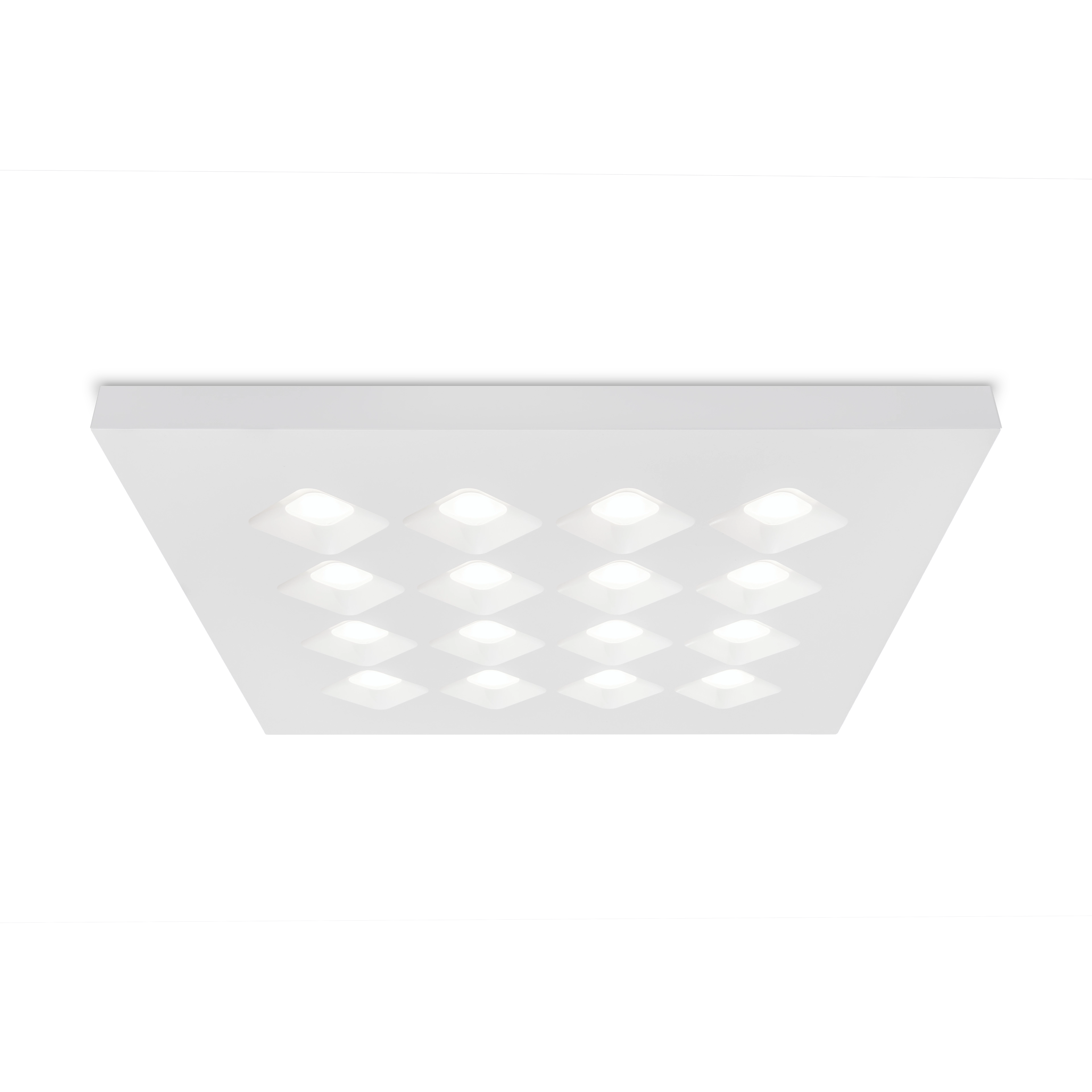
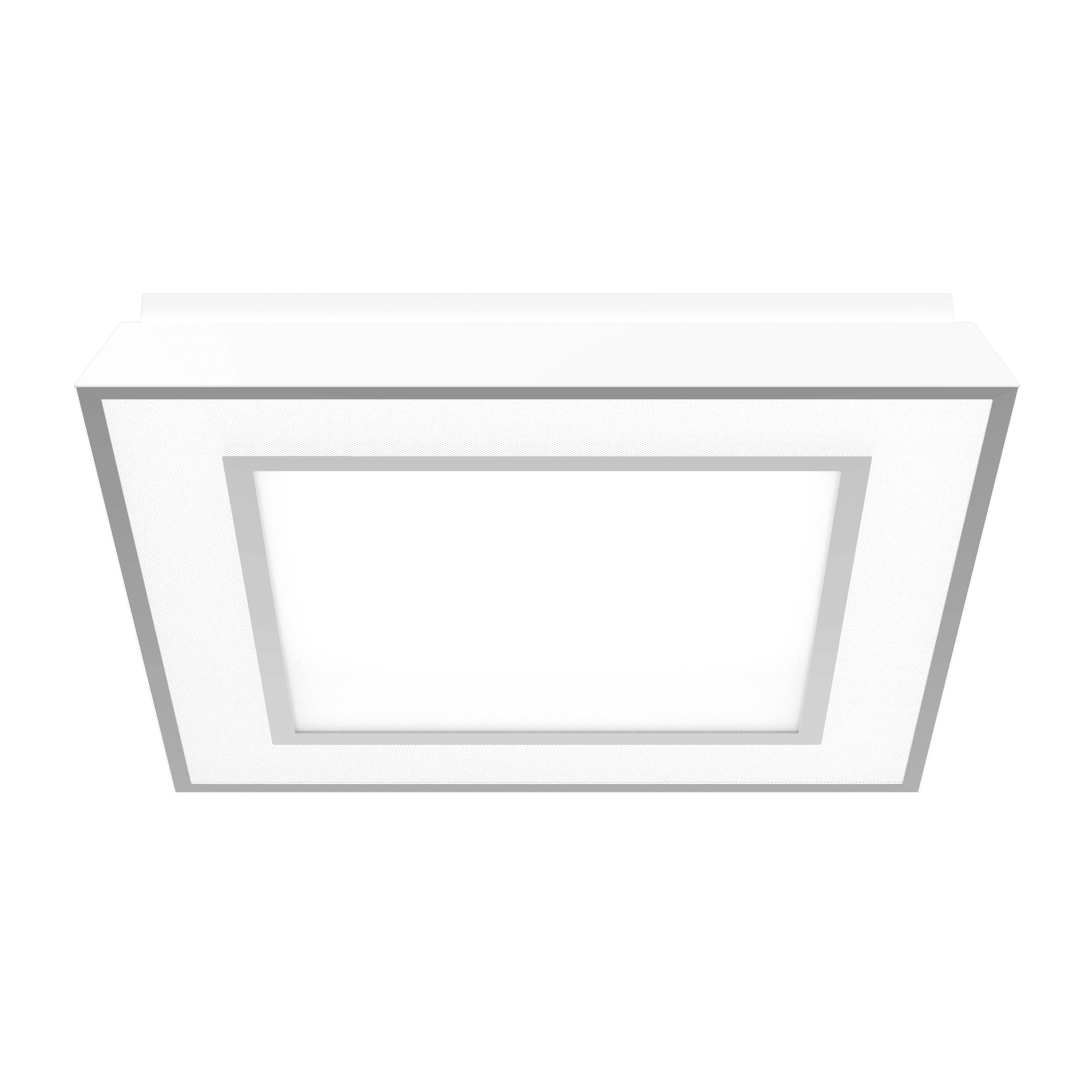
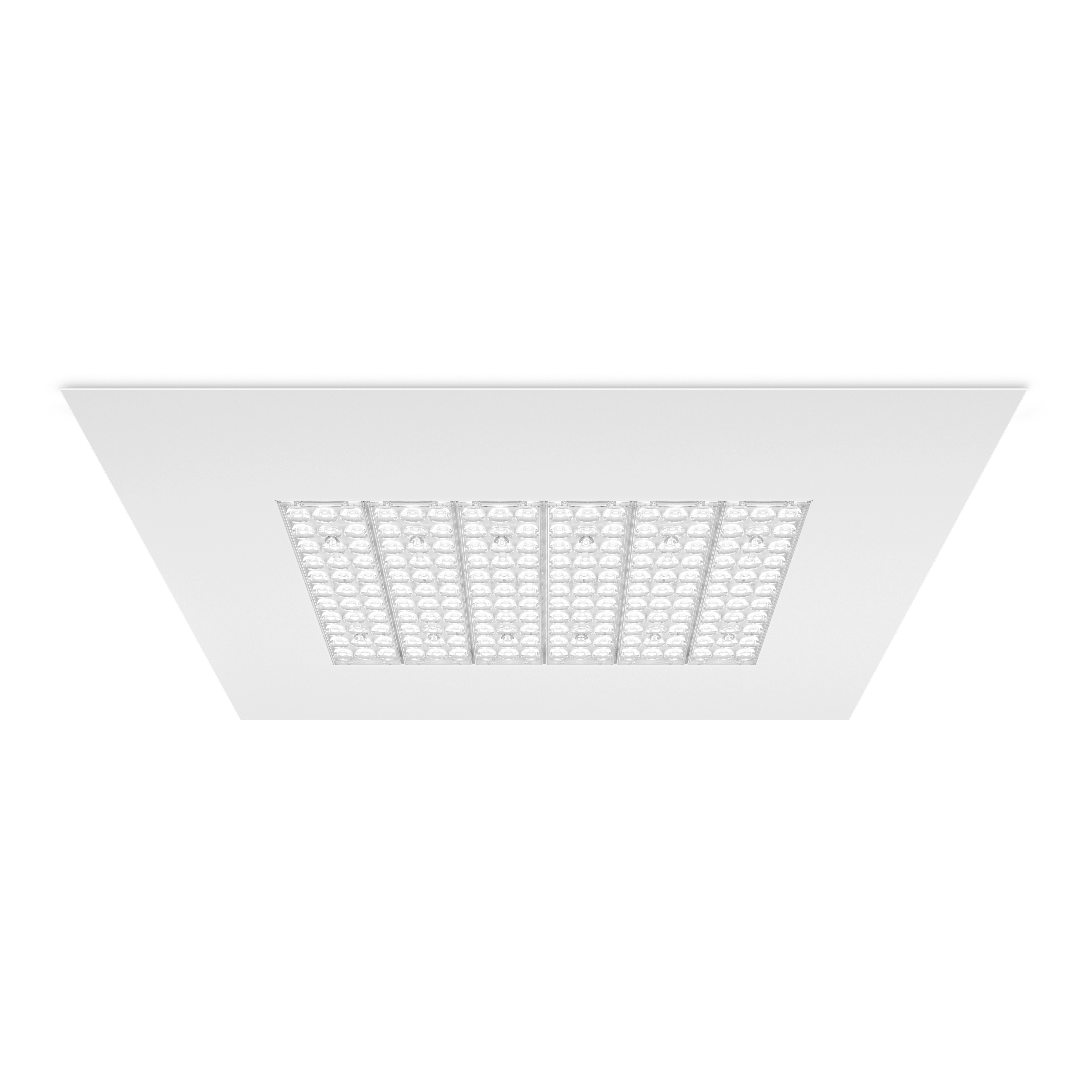
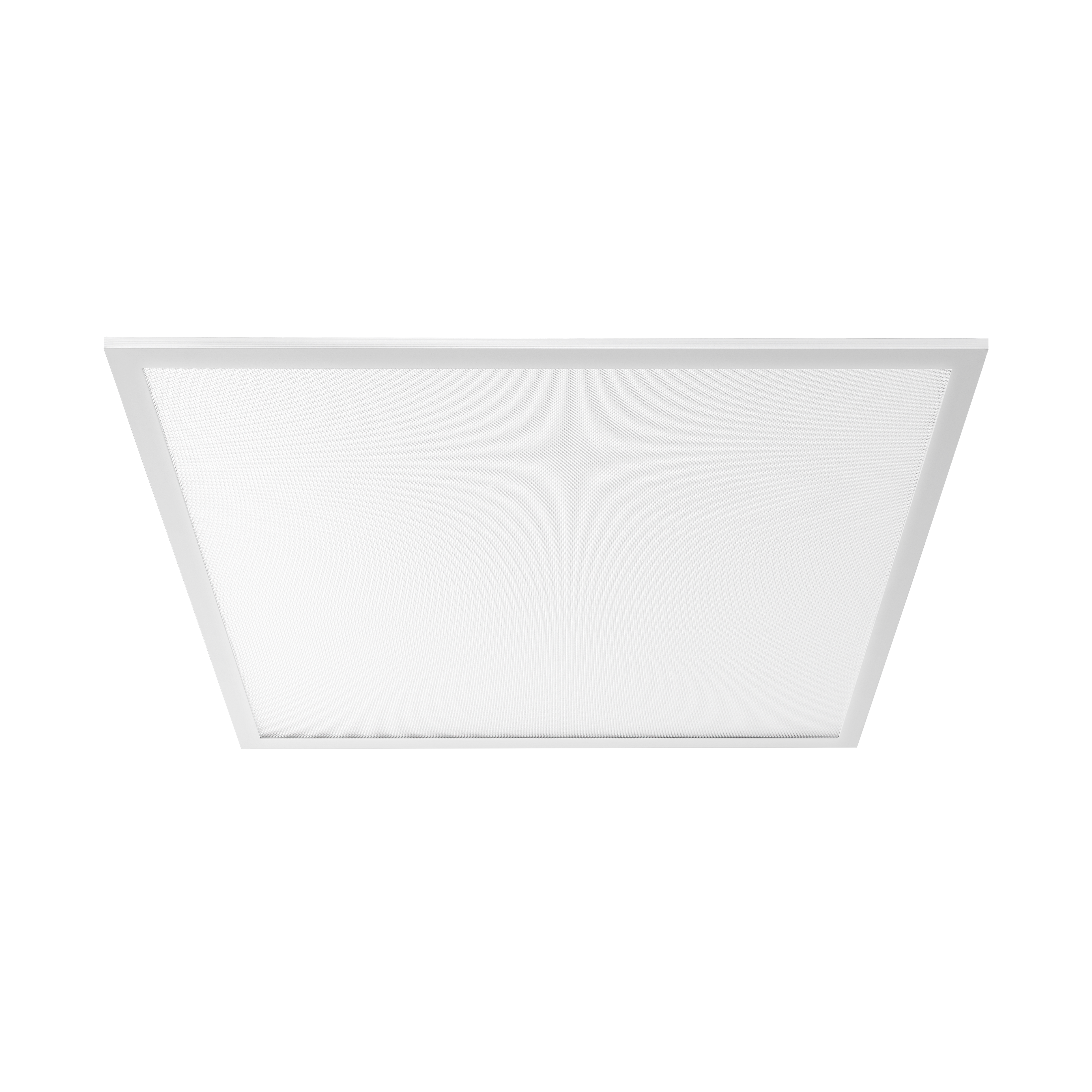
The most frequent replacements in European offices, with the real power drawn by the existing installation (lamp plus ballast) and that of the 3F Filippi LED luminaire taking its place. The values are indicative: the right luminaire is decided by the lighting calculation, because with LED it is often possible to reduce the number of lighting points as well.
| Existing luminaire | Power drawn | 3F Filippi LED replacement | LED power | Saving |
|---|---|---|---|---|
| Recessed 600×600, 4×18 W T8 | ≈ 80–100 W | 3F LED Panel, 3F Eldorado, L 340 | 30–36 W | ≈ 60–65% |
| Surface-mounted 2×36 W T8 | ≈ 80–90 W | 3F Linux, 3F Zeta | 30–40 W | ≈ 55–60% |
| 2×58 W T8 batten, 1500 mm | ≈ 125–140 W | 3F Linux, 3F Zeta | 45–55 W | ≈ 60% |
| Downlight 2×26 W compact fluorescent | ≈ 58–62 W | 3F Reno, 3F Six R | 18–25 W | ≈ 60–65% |
| Direct/indirect suspension 2×54 W T5 | ≈ 115–120 W | 3F Mirella, 3F Hal, 3F Millumino | 40–55 W | ≈ 55–60% |
| 50 W halogen track spot | 50 W | Zero 3F Track, 3F Zeta Track | 8–12 W | ≈ 80% |
Two clarifications. The fluorescent power includes ballast losses, which with old magnetic ballasts add 15–25% to the lamp rating: that is why the real saving exceeds the one calculated on nominal lamp power alone. And the saving in the table is that of the luminaire change alone: adding presence detection and daylight-linked dimming takes an office to −80% against the starting point.
A job that takes on average one to two weeks per floor, always outside working hours, following the method below.
It starts with a survey of the existing installation: type and number of fittings, heights, burning hours, condition of the wiring. On that basis the 3F Filippi technical department produces the lighting calculation for the LED solution, checking illuminance, uniformity and UGR on the real workstations. This is where you find out whether to replace one for one or redesign the grid: with LED, 500 lux are often achieved with fewer luminaires.
The audit document also contains the business case: cost of the works, annual saving, payback time, and eligibility for the available incentives.
3F Filippi office luminaires are designed with dimensions and fixings compatible with ceiling modules and existing lighting points: the 600×600 panel fits the same opening, the surface-mounted fitting covers the previous hole, the suspension reuses the fixing points. No builders' work, no chasing, no making good.
Before the works, a sample is installed in a typical room: the people who work there try it for a week, and colour temperature and optic are tuned on the judgement of those who sit there eight hours a day, not on the catalogue.
Work proceeds by zones, in the evening or at weekends: one crew replaces thirty to fifty luminaires per shift, and the next morning the office reopens with the new light. Emergency lighting is updated in the same pass with integrated-inverter luminaires, with no second pattern on the ceiling. The old fittings go to WEEE recovery.
At the end, on-site measurement with a lux meter at the workstations closes the loop: illuminance and uniformity are compared with the calculation and recorded in the report, which is also the document needed for incentives and for the safety file.
The four results a job done well delivers to the company, from day one.
Microprismatic optics designed for screen work: reflected glare on displays — the most common defect of fluorescent fittings with aged louvres — disappears, and UGR drops below 19 as EN 12464-1 requires.
The cut in consumption is immediate and can be certified by on-site measurement. Maintenance changes nature: no more tubes to replace every two years, no starters, no humming ballasts. The service life of 3F Filippi LED luminaires covers the typical horizon of a lease.
Yellowed fittings and panels with clouded diffusers are the first thing a visitor notices about a dated office. Slim-profile luminaires with uniform screens change how the space is perceived without touching the furniture — which is why relamping is often decided by marketing before maintenance.
Retrofit-ready luminaires, replacement by zones out of hours, no builders' work: downtime is zero. And the new installation is born DALI or Bluetooth, so controls can be added whenever you wish — here is what they yield.
Recessed panels in modular ceiling sizes, surface fittings that cover the previous openings, suspensions and tracks that reuse the fixing points. Each range page lists dimensions, fixings and wattages to check equivalence with the existing installation.
Other ranges suited to replacement in offices: L 340, 3F Reno, Zero 3F Track, 3F Zeta Track, 3F Linux, Binario 3F, 3F Mirella, 3F Mirella Floor, 3F Filoluce, 3F C8.
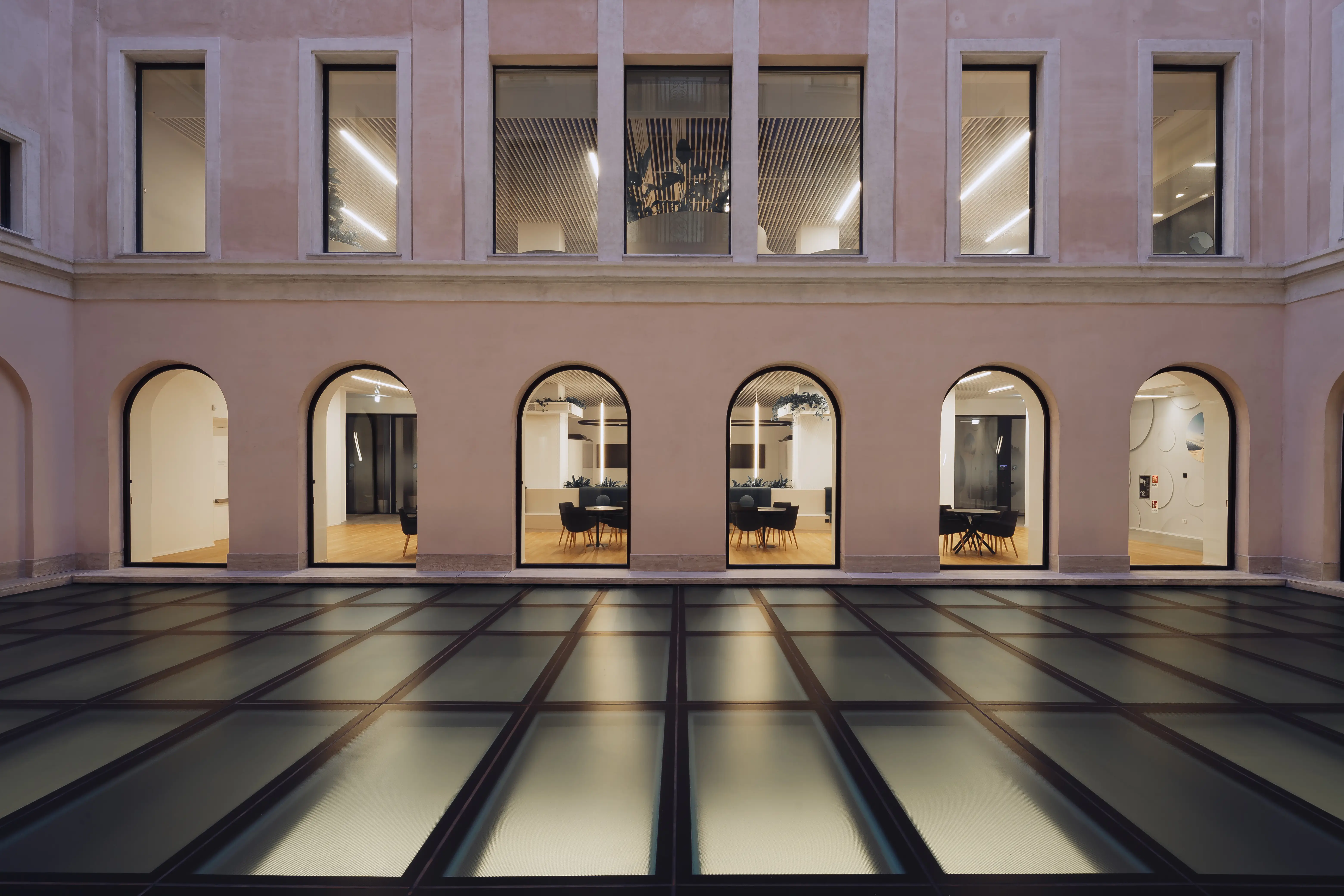
Two projects where replacing the installation changed how people work in the spaces, not just the bill.
Because it acts on three things at once: light quality, the comfort of the people working and energy consumption. Good lighting affects productivity, concentration and well-being, and in an office the light is on for every working hour: each watt saved is multiplied by 2,000–2,500 hours a year. On top of that, the fluorescent installation is almost always outside current glare requirements, and relamping brings it back into compliance.
Yes, and it is the benefit people notice most. Replacing conventional fittings with controlled-UGR LED solutions reduces glare and gives more uniform light, ideal for screen work: fewer reflections on the display, less visual fatigue, higher productivity. With just an LED tube in the old fitting, on the other hand, glare often gets worse.
LED luminaires have a much longer service life than conventional technologies and need very few interventions: no tubes, starters or ballasts to replace. They can also be integrated with control systems — DALI, presence and daylight sensors — to optimise consumption and management, with remote diagnostics that flag faults before anyone notices them.
An LED tube in the existing fitting costs less today and more tomorrow: the optic was designed for a fluorescent tube emitting through 360°, so with a directional LED the distribution changes, uniformity worsens and glare often appears. Moreover, modifying the luminaire invalidates its CE marking, and liability passes to whoever made the change. Replacing the complete luminaire costs more but delivers a certified, calculated and guaranteed installation.
With standard office hours and the luminaire change alone, typical payback is two to four years, falling below two in shift-based offices or those with many burning hours. Energy-efficiency incentives — national schemes vary from country to country — shorten the period further. The precise calculation is part of the audit our technical department prepares free of charge.
It is updated in the same job. Many 3F Filippi ranges are available with an integrated emergency inverter, compliant with EN 60598-2-22: the emergency luminaire is the same as the general lighting, stays on the same lighting points and adds no separate lamps to the ceiling. Escape routes are checked against EN 1838 in the lighting calculation, and the final report covers this aspect too.
Send a photo of the current fittings, how many there are and the burning hours: our technical department prepares the audit with the LED equivalence, the lighting calculation and the payback time. Free and without obligation.